LNR
Local Nature Reserve
L
ocal Nature Reserve is a statutory designation made under Section 21 of the National Parks and Access to the Countryside Act 1949, and amended by Schedule 11 of the Natural Environment and Rural Communities Act 2006, by principal local authorities. 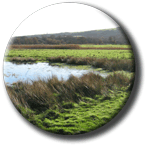
All district and county councils have powers to acquire, declare and manage LNRs. Parish and town councils
can also declare LNRs but they must have the powers to do so delegated to them
by the principal local authority. To qualify for LNR status, a site must be of importance for wildlife, geology, education or public enjoyment. Some are also nationally important Sites of Special Scientific Interest.
LNRs must be controlled by the local authority through ownership, lease or agreement with the owner. The main aim must be to care for the natural features which make the site special.
To establish a LNR the declaring local authority must first
have a legal interest in the land concerned, for example, they could own it,
lease it or have a nature reserve agreement with the owner. The land must lie
within the area which the declaring authority controls.
LNRs are of local, but not necessarily national, importance.
LNRs are almost always owned by local authorities, and they often pass the management
of the LNR onto County Wildlife trusts. They also often have good public access
and facilities. An LNR can also be an SSSI, or may have other designations (although
an LNR cannot also be an NNR). There is no legal necessity to manage an LNR
to any set standard but management agreements often exist.
An LNR can be given protection against damaging operations.
It also has protection against development on and around it. This protection
is usually given via the Local Plan, (produced by the planning authority), and
often supplemented by local by-laws. Unlike national designations, the level and type of protection afforded an LNR is decided locally, and varies from site to site.
To find out more, including the process of designation, see
the Natural England LNR website.
Information on this page applies to England only but other
national equivalents may exist.


 Pages marked with this symbol are exclusively written for
Naturenet
Pages marked with this symbol are exclusively written for
Naturenet