Areas of Outstanding Natural Beauty
& National Scenic Areas
A
n AONB is designated for its landscape and scenic beauty. 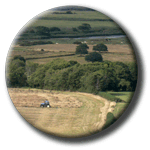 This
means that an AONB is not necessarily an area of high nature conservation value,
but in practice it often includes many areas which are.
This
means that an AONB is not necessarily an area of high nature conservation value,
but in practice it often includes many areas which are.
There are 46 AONBs in Britain (33 wholly in England, four wholly in Wales, one that straddles the Anglo-Welsh border and eight in Northern Ireland). In Scotland a comparable designation is the NSA.
The difference between AONBs and National Parks: AONBs and National Parks
are actually of equal importance for landscape and scenic beauty. The government stated in the National Planning Policy Framework (March 2012) that AONBs and national parks have equal status when it comes to planning decisions on landscape issues. The difference is that AONBs exist for the purpose of conserving and enhancing their natural beauty. National Parks, in addition to this, have a second purpose - to promote understanding and enjoyment of the area's special qualities by the public. Because of this extra (and substantial) layer of responsibility they have their own independent National Park authorities with full planning powers running them. There are other more subtle differences. The National Parks conservation and enhancement purpose specifically includes "wildlife and cultural heritage". Nowhere in AONB legislation is cultural heritage covered.
The Countryside and Rights of Way Act 2000 brought in new duties for conservation boards responsible for AONBs. These duties include meeting demands for recreation (without comprising the original purpose) and safeguarding rural industries and the interests of local communities.
AONBs are designated by Natural
England ,
in England, and the Countryside
Council for Wales
in Wales. The Scottish equivalent of an AONB is a National
Scenic Area,
designated by Scottish Natural
Heritage.
NSAs are not exactly the same as AONBs, and this difference is likely to become
more pronounced since devolution.
,
in England, and the Countryside
Council for Wales
in Wales. The Scottish equivalent of an AONB is a National
Scenic Area,
designated by Scottish Natural
Heritage.
NSAs are not exactly the same as AONBs, and this difference is likely to become
more pronounced since devolution.
The designation usually covers a wide area and many types and
uses of land. Not all parts of an AONB are necessarily open to the public. In
fact, most are not, as they are privately owned just like anywhere else. Towns
and villages are sometimes included, and often small areas which are not at
all beautiful get included too.
An AONB usually has special funding to help promote good management
and sustainable development within it. It also may have planning restrictions
to prevent unsympathetic development. Each AONB must have a management plan, and is managed by an AONB Partnership or a Conservation Board. However, although there is a duty on all public bodies and statutory undertakers to 'have regard' to the 'purpose of conserving and enhancing the natural beauty of the area of outstanding natural beauty.' when undertaking their work, there are limited statutory duties on local authorities to proactively do anything in an AONB.
AONBs vary greatly in the degree and type and level of funding
and activities found there. Some AONBs, such as Chichester Harbour,
have their own authorities and are in some ways similar to National
Parks.
Others have far more modest arrangements.
National Scenic Areas
were first identified in the report "Scotland's Scenic Heritage",
published by CCS in 1978, and were accepted as the practical basis for landscape
conservation in Scotland. They cover about one million hectares, or approximately
one eighths of the land and inland water area of Scotland. As in an AONB, protection
is achieved in two ways: through planning control and by encouraging sustainable
land management.
• Natural
England: includes maps of AONBs and lots of other info.
• The
National Association of Areas of Outstanding Natural Beauty


 Pages marked with this symbol are exclusively written for
Naturenet
Pages marked with this symbol are exclusively written for
Naturenet